
Tea livestreams love to highlight how pretty their tea is, and many tea shops advertise good looks as a hint that it also tastes good.
Is that really so?
The short answer: not necessarily.
Where good-looking tea comes from
Picked tender
Take pu-erh. If you think like a green-tea maker, you prefer tender picking - one bud with two or three leaves, some even insisting on no more than one bud with two leaves - so the compressed or loose tea looks nicer.
In reality, experienced pu-erh makers prefer picking one bud with three or four leaves, which gives better flavor.
Tender is pretty, but not necessarily tasty.
Plantation tea
Plantation tea grows very fast, with many buds and obvious pekoe; loose tea looks better and cakes look prettier.
Ancient-tree tea is coarse, with huangpian (yellow leaves), and does not look good.
Yet ancient-tree tea costs dozens of times more than plantation tea, or more.
Special varieties
A brand in Kunming presses Jingdong da baihao into cakes and sells them in livestreams as "single-tree ancient Laobanzhang or Bingdao" at sky-high prices.
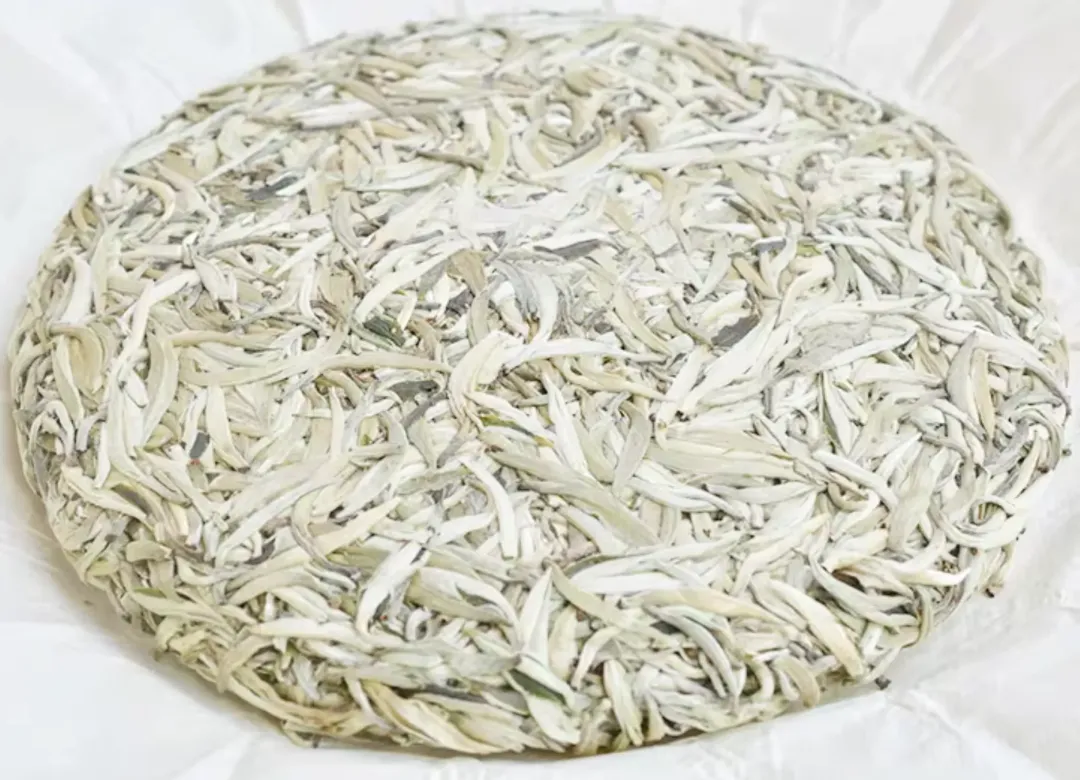
Jingdong da baihao is very beautiful (see above). Many newcomers fall for the looks and pay a fortune.
A cake that costs a dozen yuan sells for thousands; it is said the owner - allegedly a singer - harvested close to a hundred million in profit within months. Of course, many buyers later figured it out and went to the livestream to curse, only to be blocked. By now they seem scared off and are no longer streaming.
Pretty tea is not necessarily good tea.
Tea that does not look good may be high-end
Many ancient-tree spring teas are picked quite old
Many of the guarded ancient-tree spring teas I make myself are picked old - one bud with three or four leaves - and I usually do not remove huangpian when pressing cakes, because it tastes better that way. A tea friend who did not know much about tea once saw my cake and joked: "Lu, did you sweep this up from under the tree to press it?"
I deliberately pick one bud with three or four leaves and keep the old leaves because I have compared: the flavor is better and the liveliness is better too. It is easy to test - brew one infusion of my cake with the huangpian removed and one without, and compare.
So my guarded ancient-tree spring tea may not be "traditionally good-looking", but it tastes great and is high-end.
Many classic Yiwu old teas look rough but taste wonderful
I regard all of the six ancient tea mountains as the Greater Yiwu tea region. Yiwu has many delicious old teas, mostly coarse branches and old leaves - not pretty, yet some are industry classics with superb flavor. This is one important reason Yiwu stays popular: besides taste, these old teas serve as living evidence.
One more word: a certain "Big Cabbage" - hugely famous, over ten million yuan a piece - I have had the luck to drink a few times. My honest verdict: it is a decent tea, full and stimulating with a fine aftertaste, but it lacks the refinement I love; I never found a picture I enjoyed, and my body felt average. I believe it is not suitable for regular drinking.
Conclusion
Tea is for drinking - being delicious is the only standard.
When I look at my spring-guarded cake with its huangpian, I find it very beautiful, full of tension; traditional aesthetics just call it "not pretty".
Many evaluation systems today still grade appearance, with no small weight - isn't that ruining tea drinkers for life?
Comments (0)