
Earlier I wrote an article, How to Drink Tea Healthily?, which drew a great deal of attention and was widely reposted; it was about the dos and don'ts of drinking tea. This time I want to anchor on one specific point: "healthy tea", and talk about it from the perspective of traditional Chinese medicine.
Starting in 2017, we began producing tea that is completely and thoroughly processed: the eighth crowdfunded tea. If you are interested, you may try it.
Ever since, I have kept researching how to make relatively healthy tea from the angles of processing and raw material.
I have touched on healthy tea in several articles, but no single dedicated article has explained it thoroughly. Let me set the concept straight here.
Part One: What Is Healthy Tea?
1. The concept.
The healthy tea I have in mind has the following traits:
a. The tea itself is free of damp-cold.
In recent years I have been self-studying TCM, reading books and consulting TCM friends — always, of course, around the angle of tea and health preservation. I do not practice medicine, nor do I aspire to. I have had multiple TCM practitioners taste the teas I make and the healthy tea as I understand it, and the verdicts were very favorable: they all considered it free of damp-cold and suitable for drinking generously.
b. New tea can be drunk.
"The older, the more fragrant" has made storing new tea a pu-erh culture in itself. A double-edged sword, that very phrase has also burdened pu-erh with no small amount of criticism.
Time can indeed soften a tea's mouthfeel and refine its aroma, but damp-cold truly cannot be aged away. Twenty-year-old raw cakes are everywhere these days; I have drunk many samples, and the damp-cold is still there, with harsh, hard liquor soup all over the place.
From a health standpoint, aging has not really turned into fragrance.
Healthy tea means making new tea drinkable — and drinkable in quantity.
c. Making tea drinkable in quantity.
I often latch onto a single tea and drink it hard, for days on end.
If a tea can withstand that kind of treatment — many infusions in a day, drunk continuously for days — and still remains enjoyable, then to me that tea does not make my body protest; it pleases my body. That is healthy tea.
When I finish making tea in the spring, I do not press it into cakes right away, for two reasons.
One is to let the tea "sweat". After months of aging, the tea is more conducive to later transformation.
The other is that quite a few of our teas need blending. For instance, this year's Houyue Yiwu Zhengshan, Xiao Lan, Da Lan and Lan Lan all require me to understand the flavor strengths and weaknesses of each blending scheme, so I drink the candidate teas densely, one scheme at a time, for days in a row. Only if that scheme's tea can hold up do I finalize it.
Fellow tea makers can adopt this same method; it will dramatically raise the quality of your blends.
Of course, you can also use it to test my teas, or to compare teas from other brands and other colleagues. Which is better and which is worse — your body will tell you.
d. Letting even the tea-sensitive drink tea.
Many people are highly sensitive to tea — insomnia, stomach ache, weakness after drinking. They can all try my "healthy tea".
I have run sample tests on dozens of people, and I can say the results have been remarkable.
Of course, individual differences and differing constitutions mean this topic needs continued research.
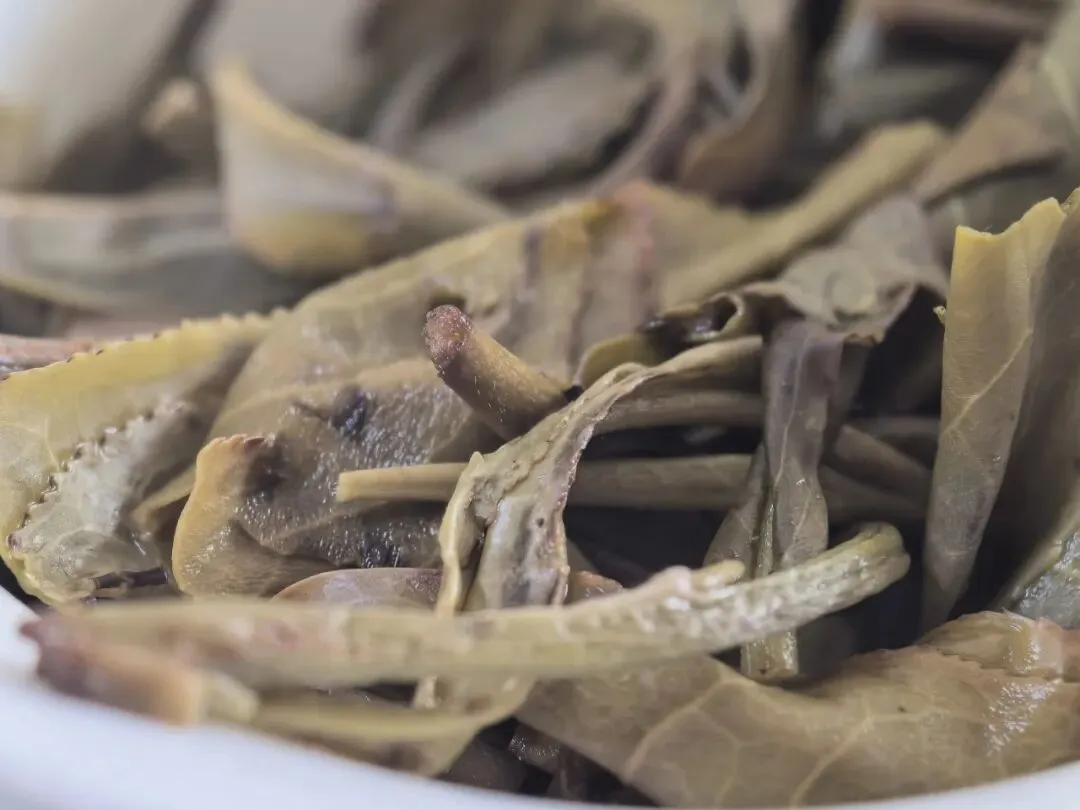
Above: the infused leaf of the 2026 Houyue Yiwu Zhengshan raw cake, one of the healthy teas I most recommend.
2. Measure.
a. Look at tea with a divided eye.
Aconite is toxic, yet it is used as medicine and is a very important herb in TCM.
Tea can dispel toxins, break solitary gloom, and quench thirst — but overdrinking it can also readily lead to damp-cold in the body.
So healthy tea is a necessity.
The young, with their restless, unplaceable youth, need thick, rich milk tea;
their elders, mature and steady, need tea that has flavor within plainness — and so pu-erh caught fire.
Healthy tea will not suit everyone, and neither will this article.
b. Nothing is absolute.
The contrarian will insist: your healthy tea still has damp-cold, because damp-cold can never be fully removed.
Fair enough — there is no tea absolutely free of damp-cold.
There are only teas relatively free of it. This is the question of measure: just as you cannot drink only tea and never water, cannot work without ever having a weekend, and cannot drink a single tea your whole life — life itself is never one unchanging state.
That is measure. The damp-cold in healthy tea is at a level where your normal drinking volume will not cause side effects in the body, will not bring on "tea sickness".
c. Excess is as bad as deficiency.
I. Must raw tea be roasted before drinking?
Roasting tea can be one way of drinking it, but it cannot be the only way, or the main way.
Roasting easily weakens a tea's fragrance and mellow depth. If the tea does not even taste good — there are plenty of healthy drinks; why choose tea at all?
II. Drinking only ripe tea.
Ripe tea also has damp-cold; compared with raw, it is merely somewhat gentler.
Drinking only ripe tea for the long term is fine, only the flavor range is not rich enough. If pu-erh had no raw tea, it would be as if time had lost its color.
III. Drinking only old tea.
As said above, old tea also has damp-cold; compared with new tea, it is relatively gentle.
Drinking only old tea over the long term greatly lowers the sense of pleasure — unless your body cannot drink young raw tea at all.
Why is green tea the world's most-consumed tea? Because fresh, brisk, tender fragrance is an utterly refined pleasure. Young raw tea has that same mouthfeel, plus a built-in bonus of endless aftertaste.
3. Summary.
Healthy tea is tea you can drink generously without hurting your body.
I went from a tea e-commerce operator and former tea marketer to a tea maker — that came from my temperament, and from discovering I had some gift for it.
Obsessiveness is the main cause of my current difficulties, but it is also the reason I cut my own path in the healthy-tea direction and achieved something.
Persisting may not promise a good future, but without persisting, how am I any different from a salted fish?
Healthy tea is a new topic, yet plenty of practitioners and experts of every stripe are researching it; some have studied it for years, some have merely talked about it for years.
Drinking tea healthily — why not start with the choosing of tea.
----------
Part Two: What I Have Learned Researching Healthy Tea
1. Can processing remove damp-cold from every tea?
The answer is yes: it can.
a. The state of the industry.
Processing can strip damp-cold from tea, whether it is terrace tea or ancient-tree tea, or other non-Yunnan teas such as shrub cultivars.
Rock tea removes damp-cold through fire — that is the advancement of Fujian tea craft. If Yunnan tea did not have somewhat better material, it would long ago have been finished off.
But pu-erh is a strange tea: when Fujian people come to make pu-erh, they return to the common pu-erh process, and the damp-cold becomes dreadful again.
In Fujian's tea regions, they can remove damp-cold because that is what everyone does.
In Yunnan's tea regions, they do not remove it, also because that is what everyone does.
In the tea trade, as far as I have observed, Fujian people are mostly merchants, and few are artisans.
I almost never drink pu-erh made by Fujian people — this is the reason.
This is not an attack on a region; it is an analysis of regional character.
b. Our choice of processing.
I have tried making terrace tea ripe and thorough, and the young raw tea is likewise free of damp-cold.
Over these years, the tea I have made the most is spring-harvest-guarded small trees and ancient trees; their young raw tea is free of damp-cold.
In the spring of 2026, the small trees include Mansong, Xiao Lan and Yiwu Zhengshan, and the ancient tree is Lan Lan. Go find them and try them — feel what I mean by healthy tea.
Without evidence, talk is cheap. From 2017 to 2026, spanning a decade, we have released dozens of such healthy teas. All dialectic, discussion and testing are welcome.
Since 2016 I have almost stopped drinking outside tea — this is the reason.
2. Does healthy tea require choosing material?
The answer is also yes: it does.
a. The standard.
Removing damp-cold from tea is only the minimum standard; it is not the standard of healthy tea.
It is like the certifications you see in the market — green, organic and so on — which look like a big deal. I think zero pesticide residue is the minimum standard for tea, not the standard for good tea.
The good tea I recognize is healthy tea. For tea drinking to bring delight and make the body comfortable and clear, the material needs an extra-high standard, and that is forest tea.
b. Our choice of material.
Big-tree tea from the forest has been Houyue's slogan since 2017.
The original slogan was "ancient-tree tea from the forest"; later, because printing the words "ancient tree" on packaging nearly got us fined, we changed it to big-tree tea.
That is our slogan, and it is exactly what we do.
People who know me well know that even for Laobanzhang I insist on plots with better ecology and on tea leaves picked from trees growing beneath the forest canopy.
Why choose forest tea? I have written an article on it; if you need it, please move on and read: The Ecological Beauty of Ancient Tea Trees in Yunnan!
3. Common questions about healthy tea.
a. Must the material be ancient-tree tea?
No.
Forest tea comes first. Ancient-tree tea is not necessarily forest tea, but forest tea's sense of delight and wild charm is stronger than that of non-forest ancient-tree tea.
b. Must it be spring tea?
Not necessarily.
Spring tea is of course best, but I have made some attempts — such as the first flush of summer tea in a year of little rain, and autumn tea near winter — and both turned out quite well.
If you blend, spring-autumn combinations dramatically improve cost-effectiveness without necessarily hurting quality much.
c. Is Yiwu tea the best?
In these years I have mainly made Yiwu tea. It is not that Yiwu tea is the best; it is that Yiwu's ecology has not visibly declined. There must be many similar places — any tea fully in a forest state is worth making — and I have also produced very striking healthy teas in non-Yiwu regions.
d. Is the more expensive tea the better?
Core-zone teas being expensive has some reason to it, but the premium of a core zone and its forest state are not necessarily proportional; quite often it is the fame that is appreciating.
Better to return to the point of forest state when choosing tea.
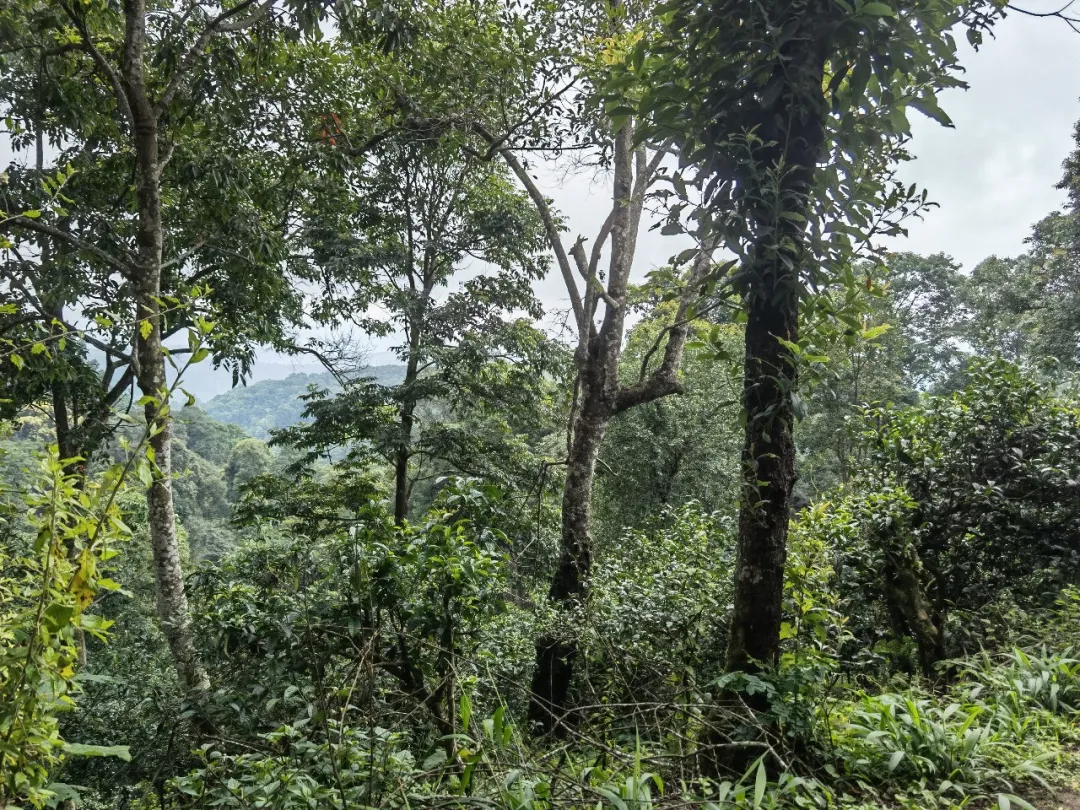
A forest tea garden
e. Is primeval forest the best?
Not necessarily.
Glyphosate has been detected even in single bushes inside Tongqing River. Forest state is not merely how things look on the surface; you must survey the ground in person and sink in for the long haul before you can know the changes of every plant, the true state of each tea garden.
Primeval forest is certainly very good, but it also needs care.
If you lack the ability to judge ecology through tasting, I suggest sending finished products for lab testing before deciding whether to invest more heavily.
f. Does more shade mean more astringency?
Not necessarily.
Astringency can be transformed into mellow sweetness; processing can change most astringency.
Tea grown with more shade has a better cooling sensation — if the processing is right.
A gentle breeze soothing the mouth, an upright, balanced force penetrating the body — this is the soul of good forest tea. A touch of astringency is not worth mentioning.
g. Is earlier spring tea better?
I like mature leaves — for instance, picking only at four or five leaves and a bud — but such leaves tend to come later.
I like the first flush of spring, whether it is picked in late April or in May.
The first flush of ancient trees is mostly one bud with two or three leaves; apart from a young-fresh note, everything else is merely average — yet the cost is far from average.
h. On healthy ripe tea.
For ripe tea to be healthy, the key is to make the raw tea ripe and thorough in the first place.
If the raw tea is made into healthy tea, then anyone fermenting the ripe tea can produce good tea.
If the raw tea was not well made, producing good ripe tea from it is hard — possible, but the odds are extremely low. On this I am still researching; I will report when there is progress.
Part Three: Summary.
Healthy tea is my personal feeling, yet it has won the recognition and following of many tea friends.
When I drink tea, I often forget the taste; I simply feel the tea is comfortable. The key to that mysterious state is a cup of healthy tea.
That mysterious state demands someone carrying the burden forward — demanding material, masterful processing.
Only then is healthy tea achieved!
----------
That is all for now. This article may be revised at any time; you are welcome to bookmark and follow.
Comments (0)