
For certain reasons I have been quite anxious these past years - yet the more I drink tea, the better I understand it, and the better I make it. Do you know why?
Because of aesthetics. I found in aesthetics the ultimate answer for tea. And aesthetics fits not only tea but wine, aged tangerine peel, and every craving of the palate.
Before 2015 I hardly drank alcohol; I thought liquor was the most unnecessary thing in the world - stimulating to taste, stimulating to the body, emboldening cowards and making people impulsive and unwise. Later, making tea myself meant tasting endless new samples, and my body grew damp-cold and heavy. Teacher Liang advised that baijiu - preferably aged baijiu - can dispel damp-cold, so I formed the habit of drinking. My capacity is small; two liang is my limit. I kept studying wine tasting: a Zhihu reviewer called A-wu reviewed baijiu, and I bought nearly every bottle he rated, experiencing them through his notes. I spent enormous time and over a hundred thousand yuan on liquor - and still did not get it. In 2016 I gave up benchmarking against baijiu and began to use the way I drink tea to understand liquor - trying to taste it with body-feel. Within one evening I understood: tasting is that simple. Then I applied this same sense to aged tangerine peel, to rock tea I rarely touched, to wine, to whisky, to all kinds of food - and suddenly it all clicked. I had my own standards at last, at least within my own field of tasting, and my own understanding of all of them.
Today I share with you the experience of many years, in one line:
The aesthetics of taste!
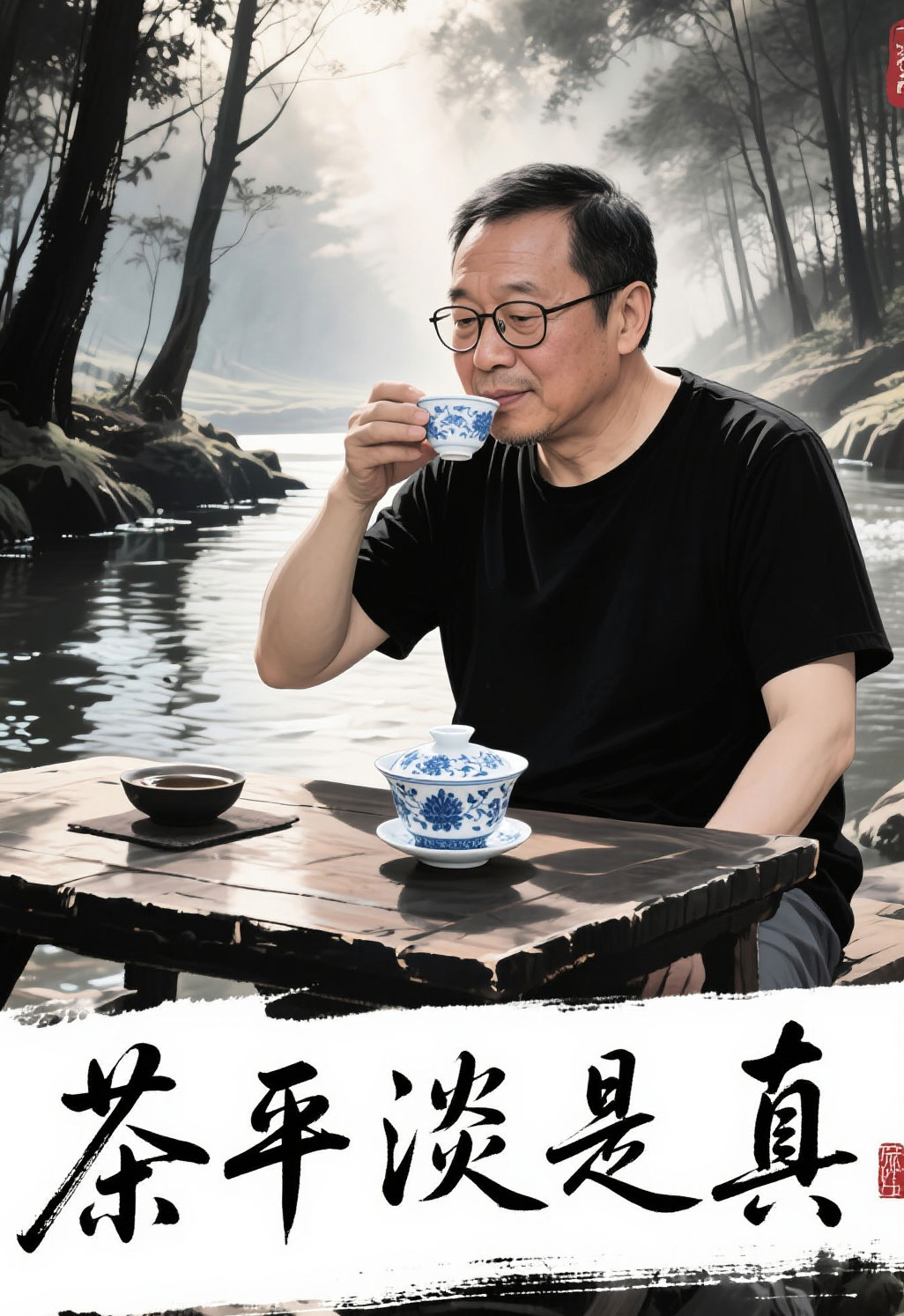
To understand tea and improve your taste aesthetics, you no longer need to memorize a tangle of parameters - bitter, astringent, salivation and returning sweetness, fullness, sweetness, thickness, smoothness, balance, calm, ecology, strength. Forget them all. Simply feel this tea's taste aesthetics.
Before aesthetics, let me speak of the ancients' wisdom.
As I mentioned, I have been anxious these years. I read a great many books and watched a great many videos, mostly Chinese classics. Because of my anxiety my memory often scrambled - authors, dynasties, people and events got mixed up - but that did not stop me. The ten-thousand-hour rule still works; I realized many things, and the most useful of them is to return to respect and recognition for traditional culture.
Since childhood we are taught to be scientific, to live and learn with a scientific mindset. Is that wrong? Perhaps not - but it is certainly not the only way. There are countless roads to understanding the world; science is just one broad avenue. There is a saying: the end of science is mysticism. I did not understand it before; now I deeply agree. One supporting sign: more and more doctors and patients accept that "the end of medicine is traditional Chinese medicine".
Look at the wisdom of the ancients - books and phrases that have survived long ages often explain a great deal in a few lines, even in a single sentence. Take "one yin, one yang - that is the Way", or "the Way that can be told is not the eternal Way; the name that can be named is not the eternal name" - a single sentence, widely circulated, deeply believed by many. By the standards we learn in school - claims need arguments, arguments need proof - is that not nonsense? How do you prove one sentence? But that one sentence may be a person's decades - even a lifetime - of insight, the lifetime summary of a sage. Is a lifetime of proof not enough? Westerners tease us for lacking rigor; we tease them for lacking romance. In truth we are just as rigorous - rigorous enough to prove with our whole lives - only we disdain to spell out the proof after saying the sentence. Those who get it, get it; those who do not, must realize it themselves. "Art comes from life" is the same truth.
What you "realize" is both experience and science. At this point, the contrarians and the scientific-data sticklers may leave.
Today I share the taste aesthetics I have realized, in one sentence:
Tea is plain, and that is truth!
The ancients said their sentence and left; I am still here, so let me unpack it.
1. Flavor economics.
The more developed the economy, the lighter the palate. Guangdong, Jiangsu, Zhejiang and Shanghai are prosperous and prefer light flavors, eating mostly the essence of ingredients.
Wealthier families also tend toward lighter palates. Even if they once loved heavy spice, as fortunes rise the palate slowly settles; even if the first generation likes strong flavors, the second generation has gone light.
The better the ingredient, the simpler the preparation: deep-sea fish eaten raw as sashimi, termite mushrooms eaten raw - and all of them are clean-sweet with wild charm. Free-range chicken can go into a clear soup, while market chicken needs braising or spicy chicken.
2. Good ingredients are clean and sweet.
Deep-sea sashimi, mountain delicacies like termite mushrooms, and tea from deep forests.
In my previous article "What Is High-End Tea" I wrote at length about the calmness of tea; here I extend it.
"Bitterness brings salivation, astringency returns sweetness" - many believe this. Such teas may be good, but they are certainly not top-tier.
Top-tier tea is clean-sweet all the way through - sweet from start to finish, with no need for bitterness. Those who insist "no bitterness, no astringency, no tea" are selling and drinking mid-to-low-tier tea. This is also why I never cared much for Mannuo tea or ordinary Laobanzhang, and why I love Yiwu tea and the deep forests of Dehong.
3. Good ingredients are full of wild charm.
"Charm" (yun) is what I emphasize constantly - it is the most essential element in how I experience any food craving.
Free-range chicken and Donggua pigs carry wild charm in every bite - everyone can feel it. Cold-sliced pork belly, if you ever visit the tea regions, is worth trying: boiled five-spice pork belly sliced and eaten cold - a flavor all its own.
Good tea and good ingredients are always naturally endowed with wild charm.
4. Tea is plain, and that is truth.
Forget the jargon. Skip the tea training classes, ignore the masters' pronouncements, stop trying so hard to "understand" tea. Feel tea directly with your body and your mouth - use the way you taste food. Do not treat tea as tea; treat it as a broth. If it tastes fresh and you can drink a lot of it, it is good tea.
Tea is plain, and only then is it true!
This is the 36th article of my "Talking About Tea on Paper" series. Click for more Talking About Tea on Paper articles.
Comments (0)